

The data landscape has evolved at a breakneck pace over the last decade. Back in 2012, Harvard Business Review famously called Data Scientist the “Sexiest Job of the 21st Century.” But as we navigate through 2026, the conversation has shifted. Organizations have realized that an army of brilliant scientists is useless if they don’t have clean, reliable data to work with.
This realization has brought the “architects” of the data world into the spotlight. Today, the choice isn’t just about “working with data”—it’s about where you sit in the value chain. Are you the one building the refinery, or the one creating the fuel?
If you are standing at the crossroads of your career, understanding the nuances of Data Science vs Data Engineering is the most critical decision you will make this year. At SLA Consultants India, we’ve seen thousands of professionals grapple with this choice. Let’s break down the realities of both paths to help you decide which one aligns with your DNA.
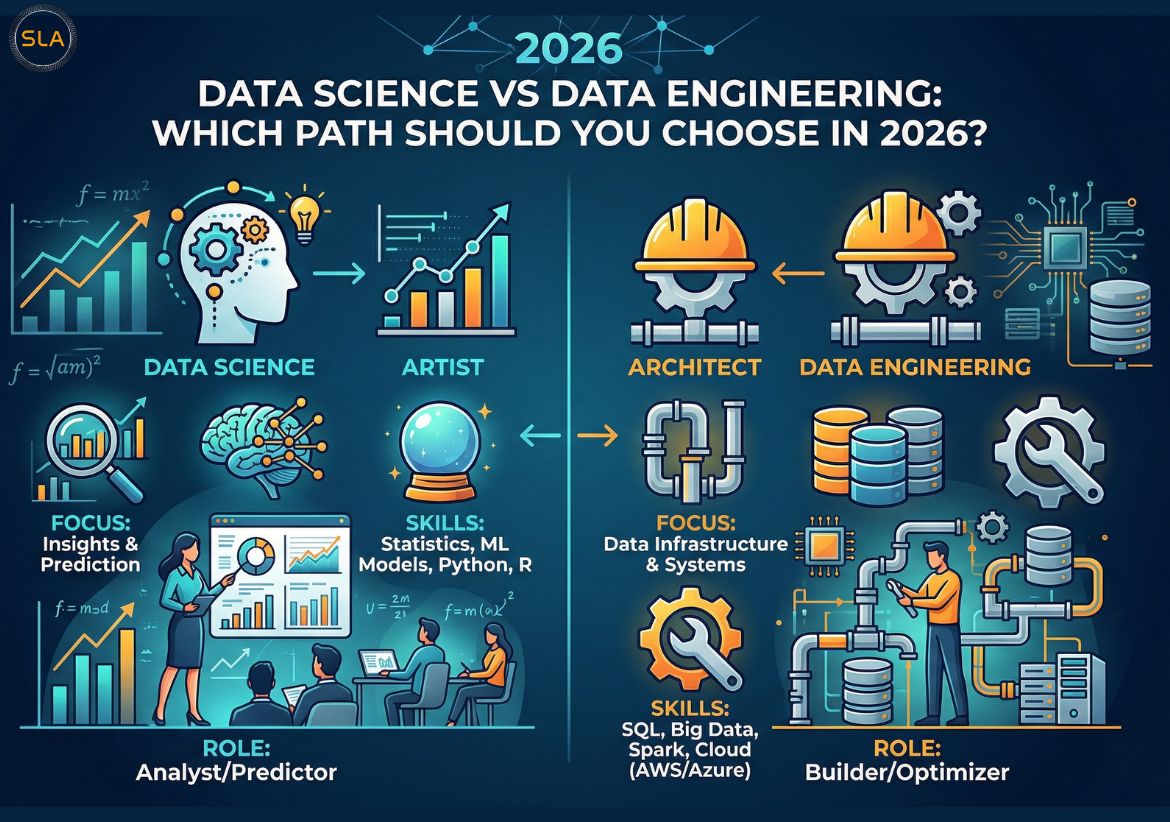
The Fundamental Difference: Architect vs. Artist
To understand Data Science vs Data Engineering, think of a high-end restaurant.
The Data Engineer is the specialized team that designs the kitchen, sources the ingredients from a dozen different farms, ensures the water is filtered, the gas is running, and the ingredients are prepped and organized in the fridge. Without them, the kitchen is just a room full of raw, dirty vegetables.
The Data Scientist is the Head Chef. They take those prepped ingredients and use their knowledge of chemistry, flavor profiles, and presentation to create a masterpiece. They don’t worry about where the onions came from; they worry about the “insights” the dish provides to the customer.
The Path of the Builder: Data Engineering
In 2026, the demand for data engineers has actually surpassed that of data scientists in many tech hubs. Why? Because of the “Garbage In, Garbage Out” rule. As companies rush to adopt Generative AI, they need massive, high-quality pipelines to feed their models.
What You’ll Do
A Data Engineer’s day is spent in the “plumbing” of the digital world. You will:
- Build and maintain ETL (Extract, Transform, Load) pipelines.
- Manage distributed systems like Hadoop or Spark.
- Work with Vector Databases for AI applications.
- Ensure data security, governance, and low-latency access.
The Tech Stack
If you love coding and systems, this is your home. You’ll master Python, Scala, SQL, Kafka, and cloud platforms like AWS or Azure. For those ready to master these “behind-the-scenes” heroics, a dedicated data engineer course is the most efficient way to gain hands-on experience with production-grade tools.
The Path of the Analyst: Data Science
Data Science in 2026 is no longer just about building a simple linear regression model. It’s about predictive power and Generative AI. Data Scientists today are focused on fine-tuning LLMs, building recommendation engines, and translating complex math into business strategy.
What You’ll Do
A Data Scientist’s day is spent in the “why” and the “what if.” You will:
- Clean and explore datasets to find hidden patterns.
- Perform Statistical Analysis to validate business hypotheses.
- Build and train Machine Learning models.
- Communicate findings to stakeholders through storytelling.
The Tech Stack
You’ll live in Python, R, and Jupyter Notebooks. You’ll master libraries like TensorFlow, PyTorch, and Pandas. Because the analytical side requires a deep dive into programming and statistics, many professionals start with a structured data science course to master the transition from data to insight.
Comparison at a Glance: Data Science vs Data Engineering
| Feature | Data Engineering | Data Science |
| Primary Goal | Build & Optimize Data Infrastructure | Extract Insights & Make Predictions |
| Key Mindset | Software Engineering / Architectural | Mathematical / Experimental |
| Top Tools | Spark, Kafka, SQL, Airflow | Python, R, TensorFlow, Tableau |
| Deliverable | Reliable Data Pipelines | Predictive Models & Dashboards |
| Personality | “I like building things that don’t break.” | “I like solving puzzles and finding ‘Why’.” |
The Market Reality in India (2026)
In the Indian context, particularly in hubs like Delhi NCR, Bangalore, and Hyderabad, both roles are highly lucrative. However, there is a visible trend: Data Engineers are often getting hired faster. Many companies already have a surplus of “Junior Data Scientists” who can run a model but don’t know how to deploy it. In contrast, “Production-Ready Data Engineers” are rare. Whether you choose the science or engineering route, having a recognized data analytics certification on your resume acts as a trust signal for recruiters who are tired of wading through self-taught candidates without practical experience.
How to Choose? The 3-Question Test
If you are still struggling with the Data Science vs Data Engineering dilemma, ask yourself these three questions:
1. Do you enjoy the “How” or the “Why”?
If you find yourself obsessing over how to make a process run 50% faster or how to automate a manual task, you are a Data Engineer. If you find yourself asking why a certain group of customers is leaving your platform, you are a Data Scientist.
2. Mathematics vs. Software Logic?
Data Science is heavily rooted in statistics and probability. If you dislike math, you will struggle in advanced Data Science. Data Engineering is rooted in software logic, distributed computing, and “plumbing.” It’s more about how systems talk to each other.
3. Do you want to be in the spotlight?
Data Scientists often present their findings to CEOs and stakeholders. They are the “face” of the data. Data Engineers are the backbone—often invisible when things go right, but the first people called when things go wrong.
Why SLA Consultants India?
Choosing a path is only half the battle; mastering the tools is the other. At SLA Consultants India, we don’t believe in “theory-only” learning. Whether you are looking for a data engineer course to learn the intricacies of Big Data or a data science course to master R-Programming and Machine Learning, we provide:
- Real-World Projects: No dummy data. You work on industry-level problems.
- Expert Faculty: Learn from practitioners who have spent years in the field.
- 100% Placement Support: We bridge the gap between your certification and your first paycheck.
- Advanced Curriculum: Our courses are updated for 2026, including the latest in AI-integrated data workflows.
Final Verdict
In the battle of Data Science vs Data Engineering, there is no “better” role—only the role that is better for you.
The world needs the Engineer to build the future of AI, and it needs the Scientist to explain what that future means. The good news? Both roles are future-proof, highly paid, and intellectually stimulating.
If you are ready to stop wondering and start building your career, visit us at SLA Consultants India. Whether it’s an intensive data analytics certification or a specialized technical track, we have the roadmap for your success.
The data revolution is happening now. Which side of it will you be on?
No Comments