

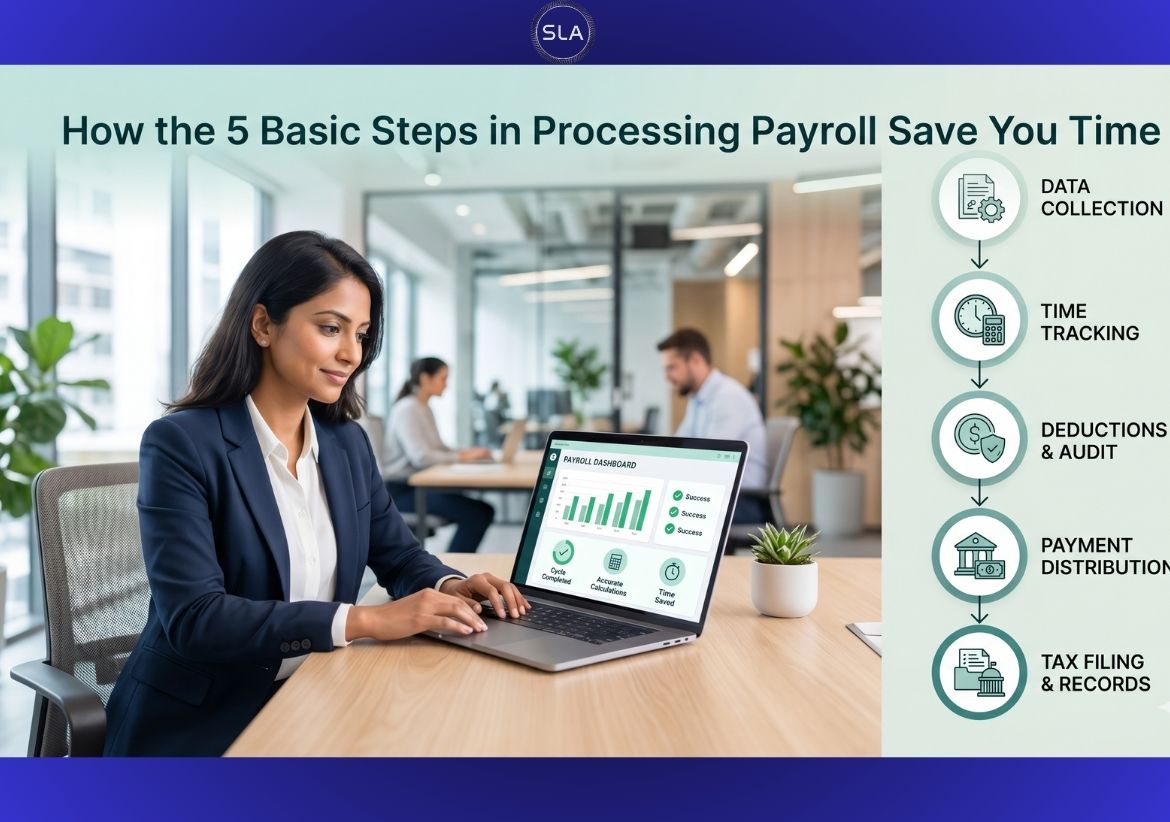
In the world of business management, time is the one currency you can’t earn back. For small business owners and HR professionals alike, the monthly or bi-weekly “payroll dance” often feels like a high-stakes race against the clock. Between calculating hours, navigating tax withholdings, and ensuring compliance, it’s easy to feel like you’re drowning in spreadsheets. However, efficiency isn’t about working faster; it’s about working smarter. By mastering the 5 basic steps in processing payroll, you can transform a chaotic administrative burden into a streamlined, predictable machine. Whether you are a self-taught entrepreneur or someone looking to professionalize your skills through an HR Payroll course, understanding this workflow is the key to reclaiming your calendar.
Why a Structured Process is Your Best Friend
Before we dive into the mechanics, let’s address the “why.” Many managers view payroll as a singular task: “paying people.” In reality, payroll is a legal and financial cycle. Without a fixed structure, errors creep in. You might overpay an employee, miss a tax deadline, or fail to document a deduction. These mistakes don’t just cost money; they cost time in the form of “rework”—the grueling process of fixing past errors.
By strictly adhering to the 5 basic steps in processing payroll, you create “internal controls.” These are safeguards that ensure accuracy the first time around, effectively eliminating the need for frantic corrections later.
Step 1: Employee Data Collection and Documentation
The first step is the foundation. You cannot pay someone if you don’t have their basic information. This includes their full legal name, Social Security number, tax filing status (W-4), and bank details for direct deposit.
From a time-saving perspective, this step should be automated. Modern HRIS (Human Resource Information Systems) allow employees to self-serve this data. If you’re finding this part of the process tedious, it might be time to look into an HR analyst course. Such training teaches you how to use data analytics and software to manage employee information efficiently, ensuring that the “inputs” of your payroll system are always clean and updated.
Step 2: Time Tracking and Gross Pay Calculation
Once you have the “who,” you need the “how much.” For hourly employees, this means collecting timecards or digital logs. For salaried employees, it means verifying their base pay and any bonuses or commissions earned during the period.
This is where most time is lost. Chasing down managers for missing timecards is a massive “time sink.” Implementing a digital time-tracking system that syncs directly with your payroll software is the ultimate life hack. In a comprehensive Payroll Certification course, you’ll learn that calculating gross pay is more than just $Hours \times Rate$. You must account for overtime laws, holiday pay, and shift differentials. Getting this right at the source prevents a mountain of HR headaches later.
Step 3: Deductions and Net Pay Determination
Gross pay is what the employee earns; net pay is what they actually take home. The distance between those two numbers is filled with deductions. These fall into three main categories:
- Statutory Deductions: Federal, state, and local income taxes, as well as FICA (Social Security and Medicare).
- Voluntary Deductions: Health insurance premiums, 401(k) contributions, and FSA/HSA deposits.
- Involuntary Deductions: Wage garnishments or child support payments.
Calculating these manually is a recipe for disaster. This is where professional education, like an HR Payroll course, becomes invaluable. Understanding the legal nuances of pre-tax vs. post-tax deductions ensures you aren’t accidentally reporting incorrect taxable income to the IRS—a mistake that can take months to rectify.
Step 4: Final Review and Payment Distribution
Never hit “submit” without a final audit. The fourth of the 5 basic steps in processing payroll is the “sanity check.” Compare the current payroll run against the previous one. If the total looks significantly higher or lower without a clear reason (like a new hire or a holiday bonus), stop and investigate.
Once verified, the funds are distributed via direct deposit, paper check, or pay card. Efficiency here relies on timing. Most banks require a 48-hour lead time for direct deposits. By having a rigid schedule for these 5 steps, you ensure that “Payday Friday” doesn’t become “Stressful Thursday Night.”
Step 5: Tax Filing and Record Keeping
The job isn’t over just because the employees got paid. You must report and deposit the withheld taxes to the appropriate government agencies. Additionally, you are legally required to keep payroll records for several years.
This step is about “Future You.” By organizing your records immediately after a payroll run, you make year-end reporting (W-2s and 1099s) a breeze. If the thought of tax compliance makes your head spin, pursuing a Payroll Certification course can provide the confidence and legal knowledge needed to handle these filings without fear.
Moving From “Doer” to “Analyst”
If you find yourself stuck in the weeds of these 5 steps every single week, it’s a sign that you need to elevate your skillset. There is a significant difference between someone who enters data into a payroll system and an HR Analyst.
An HR analyst course teaches you to look at payroll data as a strategic asset. You can analyze labor costs, predict turnover based on compensation trends, and optimize the entire workforce budget. This shift from administrative task-handler to strategic partner is how you truly save time—not just for yourself, but for the entire organization.
The Value of Specialized Training
While the 5 basic steps in processing payroll provide a roadmap, the terrain is always changing. Tax laws evolve, benefits packages become more complex, and remote work adds “multi-state” filing layers to the mix.
Investing in an HR Payroll course or a Payroll Certification course offers several benefits:
- Error Reduction: You learn the “why” behind the rules, reducing the risk of costly mistakes.
- Career Growth: Certified payroll professionals often command higher salaries and more senior roles.
- Confidence: No more “Payday Anxiety.” You’ll know exactly what needs to be done and when.
Conclusion
Mastering the 5 basic steps in processing payroll is the fastest way to turn a “necessary evil” into a streamlined business process. By standardizing your data collection, perfecting your calculations, and staying on top of your tax obligations, you protect your business and respect your employees’ time. Don’t let payroll process you—you process the payroll. Whether through better software or advanced training like an HR analyst course, taking control of this cycle is the best investment you can make for your professional sanity.
No Comments